2026 Korea Cherry Blossom Forecast | Best Dates & Spots
The Ephemeral Magic of Korea’s Spring: Why Timing is Everything
There is a specific kind of magic that settles over South Korea when the cherry blossoms—known locally as ‘beotkkot’—finally arrive. It is a fleeting window, often lasting only a week or two, where concrete jungles transform into soft pink wonderlands, making it the most sought-after season for international travelers.
Based on the latest 2026 forecast, spring is arriving earlier than usual this year. For those flying in from across the globe, understanding the north-bound “bloom wave” is essential to ensure you don’t miss the peak window and end up staring at green leaves instead of pink petals.
Quick Guide & Key Takeaways for 2026
Note: The dates and forecasts in this guide are based on the official 2026 Cherry Blossom Forecast released by Weatheri Inc. on February 26, 2026.
- Early Arrival: Most regions will see blooms 2 to 7 days earlier than the long-term average.
- The Starting Line: Jeju Island kicks off the season on March 25th, 2026.
- Seoul Peak: The capital will begin blooming on April 3rd, with full splendor expected around April 10th.
- The 7-Day Rule: Generally, “Full Bloom” (the most photogenic stage) occurs exactly one week after the initial opening.
- Strategic Tip: If you miss the southern bloom, head north or toward higher altitudes like Chuncheon to catch the late bloomers.
Landscape & Challenges: The 2026 Spring Outlook
Predicting nature is never an exact science, but 2026 is showing distinct patterns. Due to fluctuating temperatures in February and March, we are seeing a significantly accelerated schedule compared to historical norms. While this means an earlier start to spring, it also creates a challenge for travelers who booked their flights based on “average” dates from a decade ago.
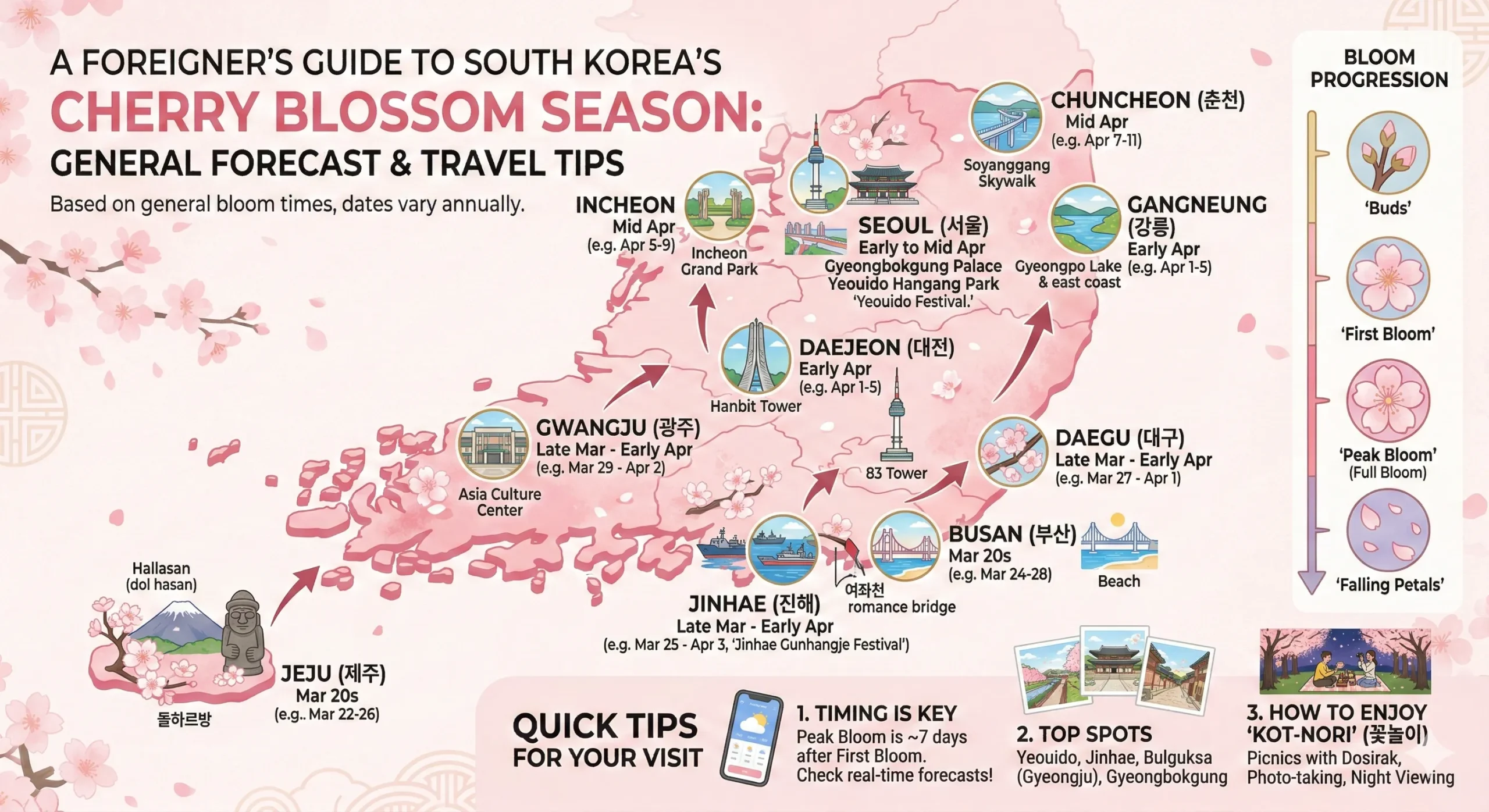
The primary challenge this year is the speed of the transition. In some central regions, the gap between the first bud and a full canopy is narrowing. This makes it vital to monitor weekly weather updates, as heavy spring rain or unexpected wind can shorten the viewing window significantly. Generally, the bloom begins in the warm southern regions and migrates north toward Seoul and the mountainous Gangwon province over a period of two weeks.
Core Guide: 2026 Bloom Dates by Major City
To help you plan your itinerary, here are the expected 2026 opening dates for major urban centers across the peninsula. Remember, these dates mark the “first bloom” (three flowers on a branch), not the peak.
- Jeju Island (Seogwipo): March 25
- Busan: March 25
- Daegu: March 26
- Pohang: March 26
- Gwangju: March 27
- Jeonju: March 28
- Daejeon: March 31
- Cheongju: March 31
- Seoul: April 3
- Incheon: April 7
- Chuncheon: April 8
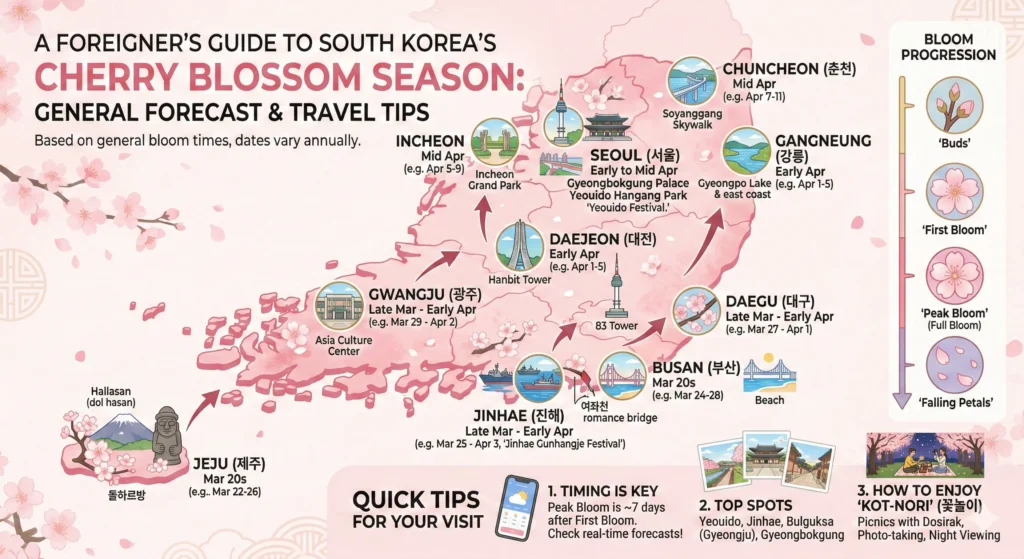
Top Cherry Blossom “Hotspots” (Clusters)
While cities are great, specific “clusters” or groves offer the most immersive experience. Here is when to visit the most famous spots:
- Jinhae Yeojwacheon (The Romance Bridge): March 27. This is arguably the most famous spot in Korea, featuring a stream lined with dense cherry trees.
- Gyeongju Bomun Lake: March 28. Perfect for history lovers, as the pink petals frame ancient Silla-era architecture.
- Hadong Ssanggyesa Temple (10-ri Cherry Blossom Road): March 29. Known as the “marriage road,” it is a legendary 4km stretch for couples.
- Seoul Yeouido (Yunjong-ro): April 3. The quintessential Seoul experience, with over 1,800 trees lining the Han River.
Comparative Insights: 2026 vs. The Past
When looking at the data, 2026 stands out. On average, the country is seeing blooms roughly 3.7 days earlier than the “normal” year. In specific northern areas like Seosan, the bloom is expected to be up to 7 days earlier than usual. Compared to 2025, the dates are fairly similar, with most cities seeing flowers 0 to 4 days earlier than last year. This trend confirms that the Korean spring is steadily shifting earlier into March, a crucial factor for those planning repeat visits.
Step-by-Step: How to Plan Your Blossom Chase
If you are landing in South Korea during late March or early April, follow this strategic “Petal Path” to maximize your chances of seeing the peak bloom:
- Phase 1 (The South): Start your journey in Busan or Jeju between March 26 and March 31. This is when the southern coastal breeze brings the first full canopies.
- Phase 2 (The Transit): Move toward central cities like Gyeongju or Jeonju between April 1 and April 5. These cities offer a blend of traditional “Hanok” villages and stunning floral displays.
- Phase 3 (The Capital): Aim for Seoul and Incheon between April 6 and April 12. This is typically the “sweet spot” for the capital’s major festivals.
- Phase 4 (The Last Stand): If you arrive late (after April 15), don’t panic. Head to the northern mountains or Chuncheon, where the cooler air keeps the blossoms alive longer, often until the third week of April.
Troubleshooting & FAQ
What defines a “Bloom”?
In standard meteorological terms, a bloom is officially declared when at least three flowers on a designated “standard tree” have fully opened. For a grove or cluster, it requires 1 to 7 trees in the representative area to show flowers on a single branch.
How long do the flowers last?
Once they reach “peak bloom” (about 7 days after the first opening), the petals are very fragile. A heavy rainstorm or a particularly windy afternoon can trigger the “cherry blossom snow,” where the petals fall all at once. Generally, you have a 4 to 5-day window of “perfect” viewing once they are fully out.
What should I wear?
Spring in Korea is notorious for ‘kkot-saem-chu-wi’ (the cold that envies the flowers). While the sun is bright, the wind can be chilly. Dressing in layers—a light sweater under a trench coat—is the standard procedure for locals and savvy travelers alike.
Are the dates guaranteed?
Please note that these are forecasts based on current climate data. Because cherry blossoms are highly sensitive to temperature shifts in March, we recommend checking the official Weatheri or Korea Meteorological Administration (KMA) websites for real-time updates as your travel date approaches.
Also traveling to Japan? Click here for the ultimate guide to Japan’s cherry blossom season.