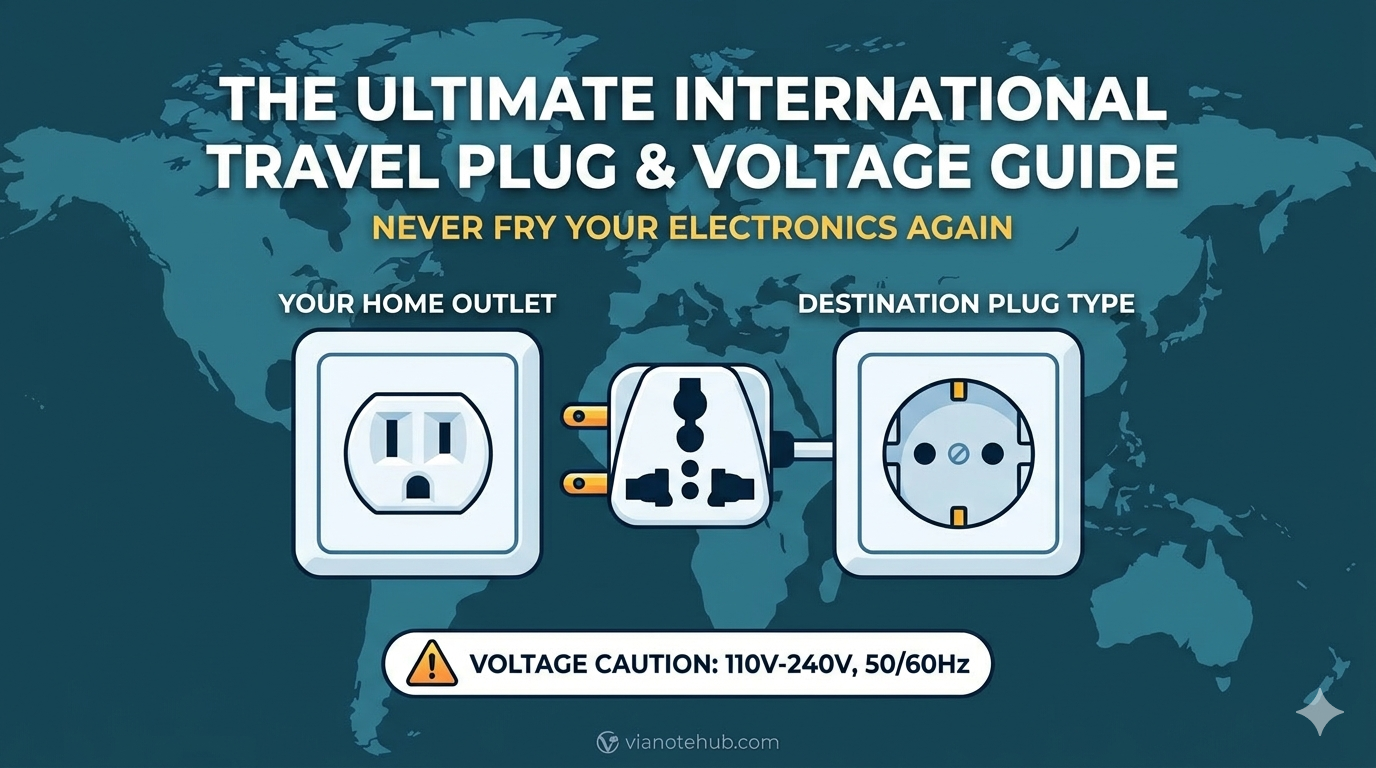
International Travel Plug Adapter Guide & Voltage Safety Tips
Travel is about discovery, adventure, and creating memories. However, nothing ruins a trip faster than the smell of burning plastic when you plug your expensive hair dryer into a foreign outlet, or realizing your phone charger won’t fit into the wall just as your battery hits 1%.
“Plug anxiety” is a real thing for modern travelers who carry an arsenal of gadgets—smartphones, laptops, cameras, and beauty tools. With over 15 different types of electrical outlets used worldwide, keeping track of what goes where is a logistical nightmare.
To solve this, I’ve developed an interactive tool at lab.vianotehub.com/travel_plug. In this comprehensive guide, we’ll explore how to navigate global electricity standards and how to use this tool to ensure you’re always powered up.
1. Why Does the World Have Different Plugs?
You might wonder, “Why can’t the whole world just use one plug type?” The answer lies in history. In the early 20th century, as electricity became a household staple, countries developed their own standards independently. Manufacturers and utility companies prioritized local safety and efficiency over international compatibility.
Today, we are left with a fragmented system. Some countries, like the USA, use the flat-pinned Type A and B, while South Korea and much of Europe utilize the round-pinned Type C and F. If you are planning a trip to Seoul, understanding these nuances is critical. For a more detailed look at the specific standards in Korea, you can read our dedicated guide on Power Plug in South Korea.
2. Visualizing Your Needs with the Travel Plug Tool
Looking at a wall of text describing outlet types is confusing. That’s why our Travel Plug Converter focuses on a side-by-side visual comparison.
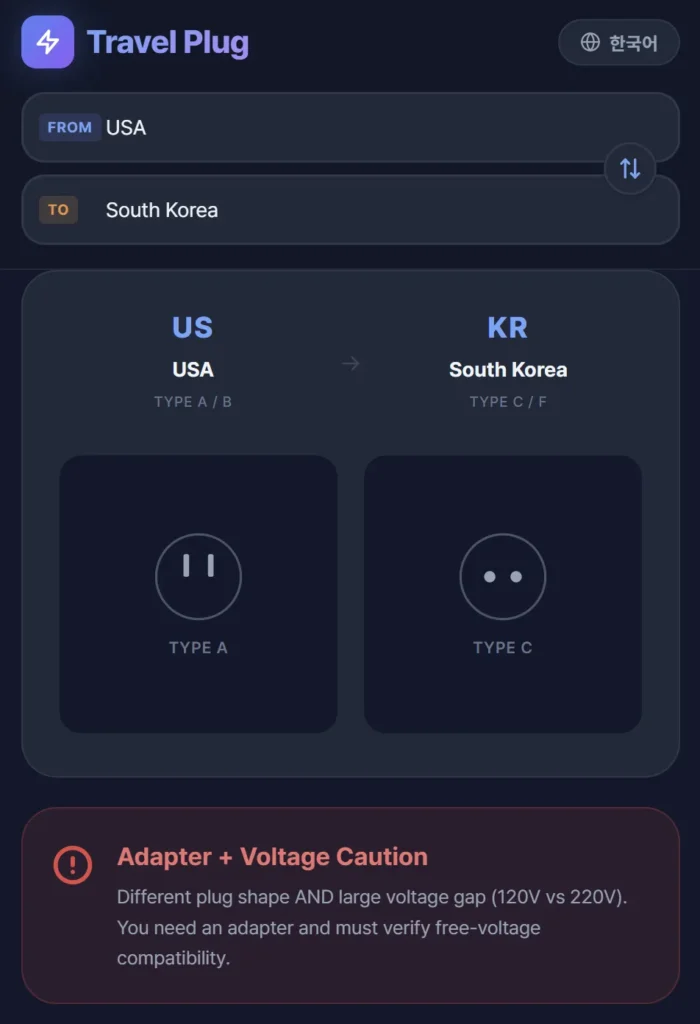
As seen in the screenshot above, when you select “USA” as your starting point and “South Korea” as your destination, the tool immediately visualizes the transition. You see the physical difference between the US Type A/B and the Korean Type C/F. This “From-To” logic removes the guesswork, allowing you to buy the correct adapter before you even leave for the airport.
3. The Science of Safety: Voltage and Frequency
The physical shape of the plug is only half the battle. The real danger lies in what you cannot see: the invisible flow of electricity.
Voltage (V): The Power Level
Most of the world operates on 220V-240V, but North America and parts of Japan use 110V-120V.
- What happens if you ignore this? If you plug a 110V device into a 220V outlet without a converter, the device will receive double the power it was designed for. This usually results in a permanent “pop” and a dead device.
Frequency (Hz): The Pulse of Electricity
Electricity alternates its direction 50 or 60 times per second (50Hz vs. 60Hz).
- Why it matters: While most modern chargers are designed to handle both, devices with internal clocks (like coffee makers) or motorized parts (like old-school hair clippers) may run too fast, too slow, or overheat if the frequency is wrong.
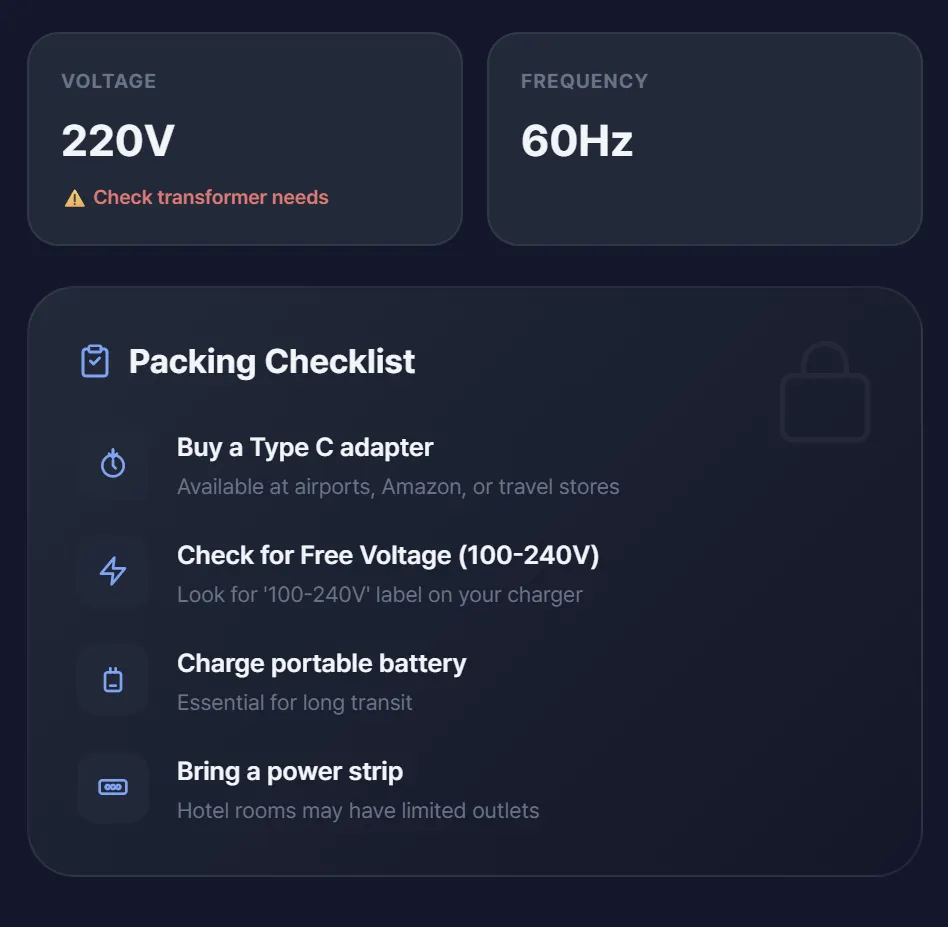
Our tool provides a dedicated “Adapter + Voltage Caution” box. It alerts you when there is a significant voltage gap (like the 120V vs 220V gap between the US and Korea). This is your signal to double-check if your device is “Free-Voltage.”
4. Is Your Device “Free-Voltage”? How to Check
Before you pack, you must perform a “Label Audit” on every electronic item. Look for the tiny text printed on the power brick or the bottom of the device.
- Dual/Free Voltage (The “Safe” Label): Look for “INPUT: 100-240V ~ 50/60Hz”. This means the device is designed to work anywhere in the world. Most smartphones (iPhone/Galaxy), MacBooks, and Kindle devices fall into this category. You only need a simple plug adapter.
- Single Voltage (The “Danger” Label): If it says “INPUT: 120V 60Hz” or “230V 50Hz”, it is NOT safe for international use without a heavy, expensive voltage transformer.
Traveler’s Warning: Beware of hair straighteners, curling irons, and cheap kettles. These are notoriously “Single Voltage” and are the #1 cause of hotel room short circuits.
5. A Professional Traveler’s Packing Checklist
To make your preparation even easier, the tool includes a built-in Packing Checklist. Let’s break down why these items are essential:
- Buy a Type C/F Adapter: For Korea, this is the standard. It’s always cheaper to buy these online or at a local store before your trip than at the airport.
- Check for Free Voltage: As mentioned, verify that “100-240V” label.
- Charge a Portable Battery: Long transits through airports often mean fighting over the one available charging station. A 10,000mAh battery is your best friend during a 14-hour flight.
- Bring a Power Strip: This is my “secret” pro tip. Many older hotels in Europe or Asia only have one or two outlets. If you bring a small power strip from your home country, you only need one international adapter to charge your phone, laptop, and watch simultaneously.
6. Interactive Lab: Why Simple is Better
There are many “Wikipedia-style” pages that list every country’s plug type. But when you are standing in a store or packing your suitcase, you don’t need a history lesson—you need a solution.
The Travel Plug was built with minimalism in mind. It’s mobile-friendly, loads instantly, and gives you the exact answer you need in two clicks. By hosting this on our “Lab” subdomain, we ensure that the tool remains a focused utility for travelers who value efficiency.
7. Conclusion: Preparing for a Seamless Journey
Understanding electricity shouldn’t feel like a physics class. By using the right tools and knowing the basic difference between a plug shape and voltage, you can travel with confidence.
Before your next trip, take 30 seconds to visit our Travel Plug Converter. Compare your home standards with your destination, follow the checklist, and spend your vacation focusing on the scenery, not the wall outlet.
Safe travels, and keep your gadgets humming!