Why Do Koreans Use Scissors at the Table? The Cultural Logic

The Mystery of the Dining Scissors: A Practical Solution to a Cultural Habit

Walking into a traditional Korean restaurant for the first time often brings a minor cultural shock when a pair of heavy-duty kitchen scissors is placed right next to your chopsticks. While scissors are strictly confined to arts and crafts or back-of-house food prep in many Western and European cultures, in South Korea, they serve as an essential, everyday dining utensil that bridges the gap between kitchen preparation and tabletop convenience.

Quick Guide & Key Takeaways:

  • The Ultimate Substitute: Korean table settings lack a dining knife, making scissors the primary tool for resizing food.
  • Communal Efficiency: Scissors allow diners to cut food directly in the air or on a shared grill without needing a flat plate.
  • Texture Matters: Highly elastic foods like cold buckwheat noodles (Naengmyeon) are nearly impossible to break down without a clean snip.
  • Hygiene Standard: Using scissors keeps hands clean and maintains a hygienic environment during communal sharing.

The Landscape of Korean Cutlery: The Missing Knife and the Plate Problem

To understand why scissors became a staple at the Korean dining table, one must look at the layout of a traditional table setting, known as Bapsang. Standard Korean cutlery consists exclusively of a spoon (Sujeo) and flat metal chopsticks. Unlike Western dining layouts that feature specific knives for steaks, fish, or butter, a knife in Korean culinary history is strictly a back-of-house kitchen tool. It belongs in the hands of the chef, and presenting a sharp blade to a guest at the table was historically viewed as aggressive or unrefined.

Furthermore, the physical structure of Korean tableware makes Western-style cutting impractical. Traditional Korean meals are served in deep rice bowls, soup bowls (Gukgret), or shared communal platters rather than flat, individual ceramic plates. Without a flat surface to press down against and “saw” through a piece of food, a standard dining knife becomes utterly useless. Scissors elegantly bypass this structural challenge by cutting food suspended in mid-air or directly on a boiling pot or hot grill.

The Cultural Shift: From Hand-Tearing to Modern Hygiene Standards

Historically, large pieces of food like aged Kimchi or cooked meats were often torn apart using bare hands or managed carefully with chopsticks. However, as modern hygiene standards evolved and communal dining dynamics shifted toward maximum efficiency, manual tearing became less desirable. Scissors emerged as the perfect pragmatic evolution—a tool that allows for rapid, precise resizing of food without requiring anyone to touch the hot or saucy ingredients directly.

This adaptation reflects a broader cultural trait in modern Korea: Pali-Pali (hurry-hurry) culture. Waiting for a kitchen chef to pre-cut every single item slows down the dining experience. Placing scissors in the hands of the diner shifts the control, allowing families and friends to customize their food sizes in real-time as they talk and cook together.

Core Guide: What Foods Do We Cut With Scissors?

It is important to note that Koreans do not use scissors indiscriminately across every dish. Soft rice, stews, and delicate fish are easily managed with chopsticks. Scissors are reserved for specific culinary categories where structural density or long fibers present a physical challenge.

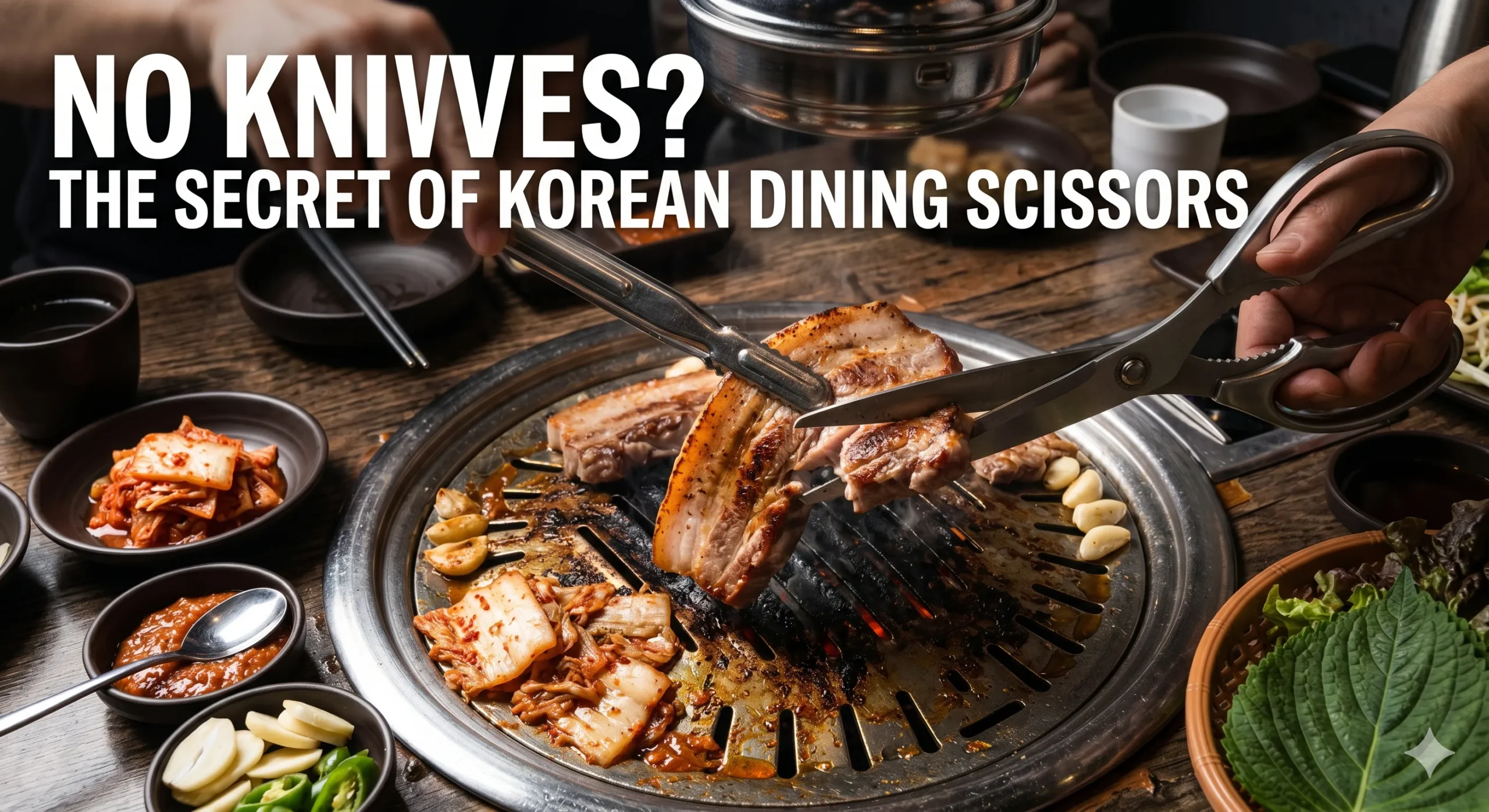
  • Korean BBQ (K-BBQ): Thick slabs of pork belly (Samgyeopsal) or marinated beef ribs (Galbi) are placed onto the tabletop grill entirely whole to retain their juices. Once the meat develops a proper sear, the designated table grill-master uses tongs and scissors to slice the meat into perfect, bite-sized geometric pieces. This ensures the meat cooks evenly and fits perfectly inside a lettuce wrap (Ssam).
  • Naengmyeon (Cold Buckwheat Noodles): This classic summer dish features long, delicate noodles made from buckwheat, potato starch, or sweet potato starch. These fibers are incredibly elastic, chewy, and long. Attempting to lift them with chopsticks without cutting often results in a messy splash of cold broth, and biting through them mid-bite is notoriously difficult. A quick cross-cut with scissors creates manageable bundles.
  • Whole Leaf Kimchi: High-quality, traditional restaurants often serve Kimchi in long, uncut segments straight from the fermenting jar to prove that the side dish is fresh and has not been reused from a previous table. Diners use scissors to snip the crunchy white stems and leafy green tops into bite-sized portions.
  • Long Rice Cakes and Stew Ingredients: Dishes like Tteokbokki (simmered rice cakes) occasionally feature long, unbroken cylinders of rice cake. Similarly, hot pot dishes (Jeongol) contain large bundles of mushrooms, glass noodles, and leafy greens that are snipped down as they simmer on the tabletop stove.
  • Portioning Food for Children: Because scissors provide unmatched precision, parents frequently use them to mince protein, vegetables, and side dishes (Banchan) directly into a child’s rice bowl, removing the need for specialized baby food processing tools at the table.

Comparative Insights: Western Table Knives vs. Korean Dining Scissors

When comparing Western dining mechanics with Korean practices, the difference comes down to leverage and spatial mechanics. A Western knife requires downward pressure applied against a solid, horizontal surface. This mechanic isolates the cutting action to an individual’s plate, emphasizing solo consumption and personal portions.

In contrast, Korean dining scissors operate on a pivot mechanism that works entirely independent of a surface. This makes them inherently communal. A single person can cut meat on a shared central grill for five other people without moving from their seat. The tool reinforces the shared, collaborative nature of the Korean culinary tradition, where eating is rarely an isolated event but rather a collective activity.

Step-by-Step: How to Use Dining Scissors Like a Local

Using scissors at a restaurant might seem entirely intuitive, but observing a few unspoken structural habits will help you handle them with absolute confidence.

  • Step 1: Coordinate with Tongs: Always operate the scissors in tandem with a pair of long metal tongs. Hold the tongs in your non-dominant hand to secure the food item, and hold the scissors in your dominant hand.
  • Step 2: Lift and Tension: For items like Kimchi or Naengmyeon noodles, lift the food slightly out of the bowl or platter using your tongs to create gentle upward tension. This isolates the section you want to cut and prevents splashing.
  • Step 3: Angle the Cut: When cutting meat on a K-BBQ grill, tilt the scissors at a slight angle rather than holding them perpendicular to the grill surface. This prevents the tips from scraping against the hot metal grate and gives you a cleaner, smoother slice.
  • Step 4: Place on the Utensil Rest: When finished, do not lay the greasy blades of the scissors directly onto the tabletop or a paper napkin. Rest the handles or blades safely on the designated metal tray, side plate, or the edge of the grill setup.

Troubleshooting & FAQ

Is it considered rude to cut noodles with scissors?
Generally, cutting soft wheat noodles like ramen, udon, or kalguksu is unnecessary and can sometimes look unusual to locals because those noodles are soft enough to break with your teeth. However, for highly elastic starch noodles like Naengmyeon or J쫄면 (Jjolmyeon), using scissors is completely standard procedure and highly recommended to avoid choking hazards.

Should I wait for the server to cut the meat at a K-BBQ restaurant?
Standard procedure varies depending on the restaurant style. In high-end establishments, servers will handle the grilling and cutting for you. In casual local spots, diners are expected to manage the scissors themselves. A good rule of thumb is to watch your server; if they leave the tongs and scissors on your table, it is your cue to take over the grilling responsibilities.

How can I ensure the dining scissors are clean?
In South Korea, table scissors are washed with high-temperature industrial dishwashers alongside standard cutlery. If you ever feel uncertain, you can naturally sterilize the tips by holding them near the heat of the tabletop grill for a brief moment before use. For peace of mind regarding specific restaurant guidelines or updated dining hours, check the official website or local map listings for updates prior to your visit.

Similar Posts

Leave a Reply

Your email address will not be published. Required fields are marked *