6 Japanese Phrases That Actually Worked in Japan
I Traveled Japan Speaking Almost Zero Japanese — These 6 Phrases Got Me Through Everything
Before my first trip to Japan, I spent weeks worrying about the language barrier. I downloaded translation apps, printed out phrasebooks, and even tried to memorize hiragana. By day two in Tokyo, I had abandoned almost all of it.
Not because I gave up — but because I realized I didn’t need any of it. What I actually needed was six phrases. That’s it.
These aren’t the six phrases a textbook would choose. They’re the ones I found myself using over and over again, at convenience stores, at ramen counters, at train ticket machines, at izakayas where nobody spoke a word of English. They worked every single time.
Why I Stopped Relying on Translation Apps
Here’s what nobody tells you about using Google Translate in Japan: it slows everything down at the worst possible moment.
I remember standing at a busy convenience store register, fumbling to open my phone while a line of commuters formed behind me. The cashier waited patiently — Japanese service culture is incredibly gracious — but I still felt awful. That was the last time I reached for my phone during a basic transaction.
The reality is that most tourist interactions in Japan are short, visual, and highly predictable. You point at something. You nod. You hand over money or a card. If you pair those gestures with even one polite word, the whole thing flows naturally.
That’s what these six phrases do. They’re not about sounding fluent. They’re about being clear, being polite, and not holding up the line.
The 6 Japanese Phrases in Japan
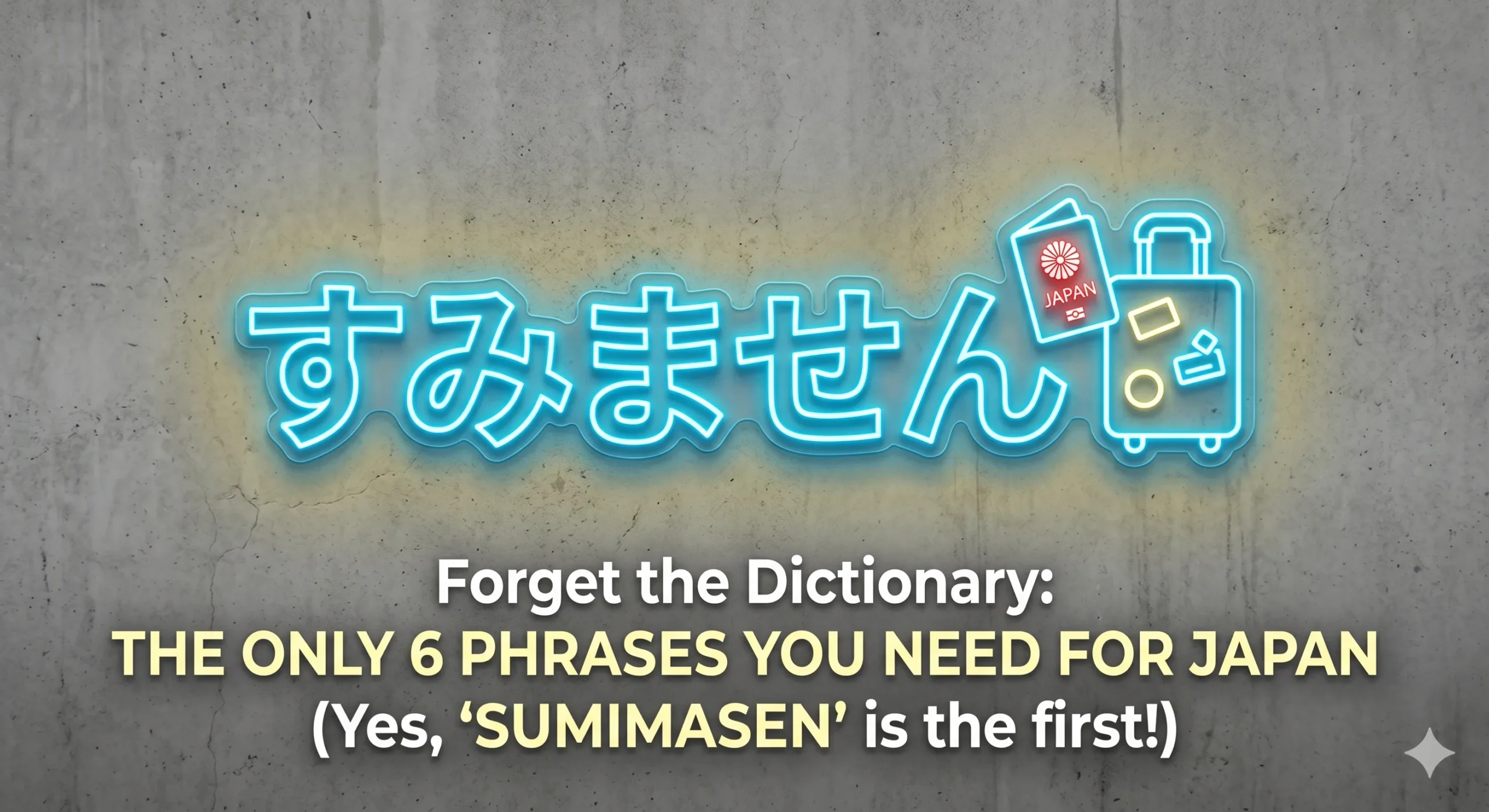
1. Sumimasen (すみません) — “Excuse me / I’m sorry”
If I could only bring one Japanese word on a trip, this would be it. I used sumimasen constantly — to get a waiter’s attention, to squeeze past someone in a crowded train car, to apologize for accidentally bumping into a person at a station.
It’s one of those words that somehow fits almost every awkward social moment. The moment I started using it, I noticed people responded to me differently — warmer, more willing to help. Showing even a small effort with the language seems to genuinely matter in Japan.
2. Arigatō gozaimasu (ありがとうございます) — “Thank you”
I said this probably fifty times a day. Every time a cashier handed me my change, every time a local pointed me in the right direction, every time a server set down my food — arigatō gozaimasu.
It’s a bit of a mouthful compared to just arigatō, but the fuller version sounds notably more polite and respectful, which is worth the extra syllables in most situations.
3. Onegaishimasu (おねがいします) — “Please”
This is the word that turned pointing into a complete sentence. I’d find the item I wanted on a menu photo or a shelf, point clearly, and say onegaishimasu. That combination — gesture plus this one word — communicated everything I needed to say.
Staff seemed to appreciate it. It signals that you’re trying to be polite rather than just demanding something.
4. Ikura desu ka? (いくらですか?) — “How much is it?”
I used this mainly at outdoor food stalls and small local markets where prices weren’t labeled. Fair warning: I almost never understood the spoken answer.
But that was fine. Every single time I asked, the merchant either typed the number on a calculator and showed me the screen, or pointed to the total on a register display. Japanese vendors are very accustomed to tourists who can ask the question but can’t parse the answer. Nobody made me feel embarrassed about it.
5. Kore hitotsu (これひとつ) — “One of this, please”
This was my most-used phrase at restaurants, and it made ordering almost completely stress-free. I’d look at the menu photos, find what I wanted, point directly at it, and say kore hitotsu. Done. No pronunciation anxiety, no guessing at unfamiliar dish names.
Many Japanese restaurants have either laminated photo menus or plastic food displays in the window, which made this approach work perfectly almost everywhere I ate.
6. Hitori desu (一人です) — “Just one person”
As a solo traveler, this was the first thing I said every time I walked into a restaurant. The host would often hold up fingers to ask how many — I’d say hitori desu and they’d immediately know where to seat me.
It made the entrance feel smooth rather than awkward, and I was usually seated quickly at a counter seat or small table, which honestly I came to prefer.
How a Typical Restaurant Visit Actually Went
Let me walk you through what a meal actually looked like using only these phrases, because I think seeing it as a sequence makes it click.
Step 1: Walking In
Slide open the door, wait to be greeted. When staff approach, bow slightly, smile, and say hitori desu. They’ll guide you to a seat immediately.
Step 2: Getting the Waiter’s Attention
Don’t wave or call out loudly — it’s not the norm in Japanese restaurants. Raise your hand slightly or make eye contact and say sumimasen clearly. They’ll come to you right away.
Step 3: Ordering
Point to the item on the menu (photos are your best friend here) and say kore hitotsu, onegaishimasu. That’s your entire order. The waiter will confirm with a nod or repeat the item name back.
Step 4: Paying
In most Japanese restaurants, you pay at the register on your way out rather than at the table. Hand over your card or cash, collect the receipt and change, and say arigatō gozaimasu as you leave. Simple and clean.
Common Worries — Answered From Actual Experience
Isn’t pointing at things rude?
I worried about this before my first trip. In practice, no — not when you pair it with onegaishimasu or sumimasen. The polite word transforms the gesture entirely. Staff consistently responded with patience and warmth.
What if I can’t understand the price they say out loud?
Just hold out your phone with the calculator app open, or gesture toward their register. This happens constantly with tourists and every single merchant I encountered handled it without any sign of irritation. They’ll show you the number, one way or another.
What if I’m not traveling alone?
Swap hitori desu for futari desu (two people), or just hold up the right number of fingers while saying sumimasen at the door. Either works perfectly.
Final Thought
I’m not fluent in Japanese. I’m not even close. But these six phrases made me feel genuinely capable of navigating the country on my own terms — at local spots well off the tourist trail, not just at English-friendly hotels and chain restaurants.
You don’t need to memorize a dictionary. You just need to show up politely, pay attention, and use the right words at the right moments. Japan will meet you more than halfway.